AvtoGlobal
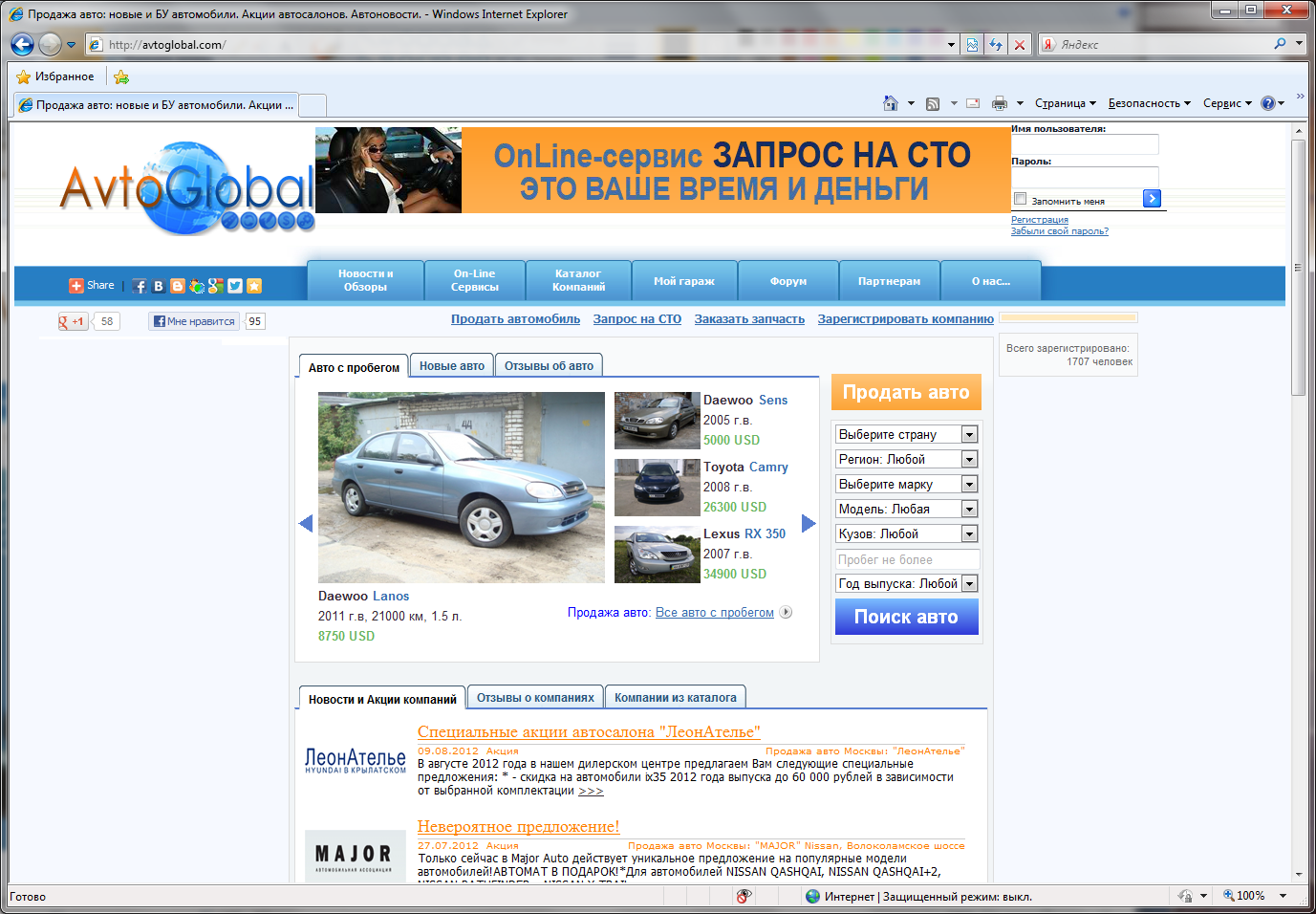
Design and development of the large-scale automotive portal AvtoGlobal — a comprehensive, multi-functional web ecosystem that unified online services for both B2C and B2B segments of the automotive market.
Business Objective & Product Evolution
Initially, the project was envisioned as a niche online service for locating car repair shops (auto repair service centers), featuring basic accounts for car owners and auto service providers. However, as the business evolved and scaled, there arose a critical need to transform the portal into a global aggregator for automotive solutions.
The main challenge for our team was to seamlessly accumulate diverse online services within a single IT architecture while ensuring high system performance during peak user loads.
Implemented Functional Ecosystem
We designed and deployed a flexible role-based access model alongside an expansive module setup that successfully covered the core demands of all user categories:
- Car Owner Account: An interactive dashboard for tracking vehicle maintenance histories, booking service appointments, finding auto parts, and discovering promo campaigns.
- Auto Service CRM Module: A dedicated workspace for service centers, enabling managers to visually monitor repair bay scheduling in real time, manage mechanic rotas, and process incoming bookings.
- Car Sales & Auto Parts Aggregator: A full-featured marketplace utilizing smart search algorithms, structured parts catalogs, and vehicle classified ad submission flows.
- Information Hub: A dynamic system for the automated broadcasting of news, press releases, and marketing campaigns from prominent car dealerships.
The Result
The AvtoGlobal portal was successfully deployed and scaled, proving our team's competency in architecting complex, high-traffic B2B2C web platforms. We delivered a product that effectively bridges the gap between everyday drivers and major auto industry enterprises.

Indoor Player
Development of a professional, high-performance platform for centralized management of a distributed network of advertising screens, media facades, and outdoor LED panels.
Problem and Initial Objectives
The initial customer requirements focused on the implementation of independent media players controlled by XML configuration files. The project involved the creation and seamless integration of the following key components into a single broadcast grid:
- Video Player: A module for looping heavy commercial high-resolution videos (MPEG2/4, AVI, WMV) and graphics.
- WPF Clock: A customizable time widget for keeping audiences informed.
- Ticker: A module for smoothly broadcasting text news and announcements with dynamic data loading from local or remote XML/RSS resources.
- Video Capture Module: A component for capturing and displaying live streaming images from external sources (TV tuners or cameras) directly within the ad layout.
At the stage of individual component testing, the problem seemed solved. However, practice is a stubborn thing. Once all these players were running simultaneously on a single machine to form a complex advertising screen, the requirements changed dramatically.
Typical solutions couldn't handle the parallel load: micro-delays and black screens occurred between video playbacks, the processor was overloaded to 100%, and system memory was rapidly leaking, which led to equipment freezing at remote points.
Implemented solution
Instead of overlaying temporary software We completely redesigned the system architecture with a focus on maximizing the performance of native WPF components (XAML). We've delved deep into the root of the resource optimization problem:
- Zero Latency: We rewrote the background caching and content preloading logic, completely eliminating pauses and flickering when changing playlists and transitioning from one heavy video to another.
- CPU Optimization: We switched video stream rendering to hardware acceleration on the video card, reducing the load on the CPU to minimal values.
- Memory Leak Prevention: We implemented strict lifecycle control for objects and media contexts. The system is capable of continuous operation 24/7/365 without accumulating garbage in RAM.
Result
We successfully delivered the project, significantly exceeding the client's stringent technical expectations for software stability and energy efficiency. The WPF controls we developed have proven themselves to be reliable in real-world conditions.
SOS Access V3
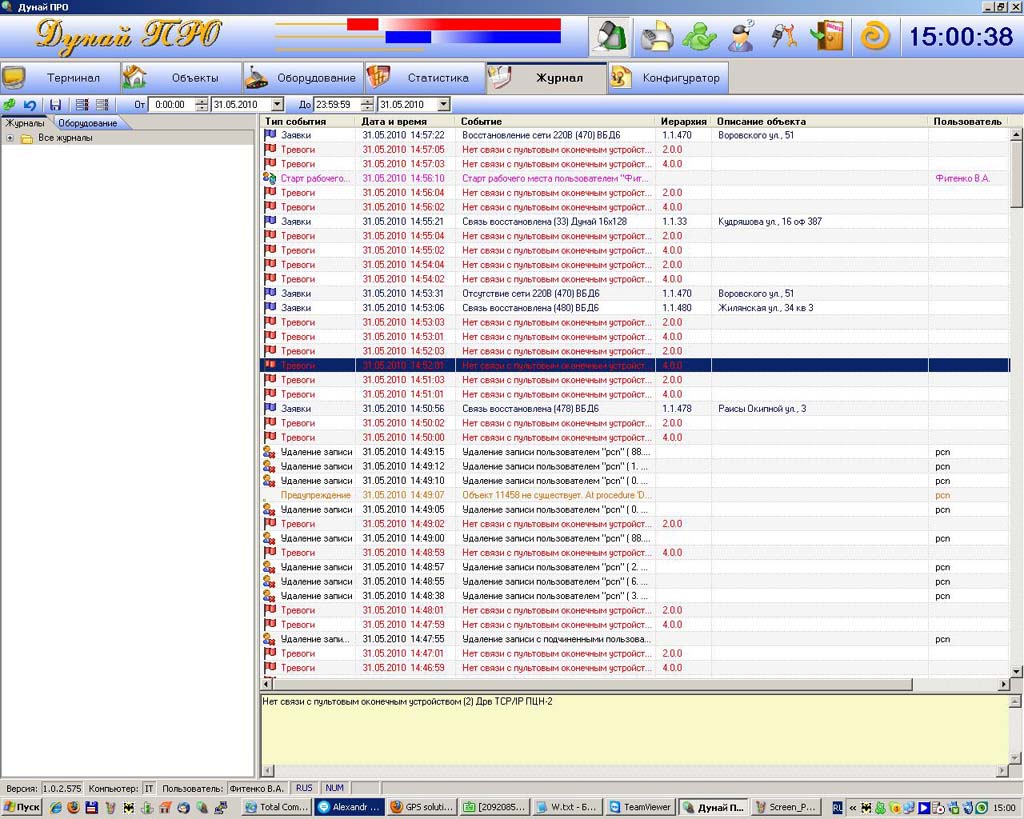
Design and development of a highly reliable software system for instantaneous transmission of emergency alarm signals from monitored facilities to the central EMERCOM monitoring station via the specialized SOS Access V3 international protocol.
Business Task & Hidden Technical Complexities
Our team was tasked with automating and securing the emergency call dispatching process. The primary challenge of the project lay in the lack of consistency across the client's legacy infrastructure. We conducted a deep analytical audit and resolved several critical bottlenecks:
- Facility Structure Inconsistencies: In practice, we uncovered an issue where alarm signals from one group of objects were transmitted correctly, while completely failing from others due to configuration desynchronization. We thoroughly analyzed the architecture and established a unified verification logic for all monitoring endpoints.
- Sensor Hardware Anomalies: A similar pattern occurred at the end-device level (perimeter, smoke, and intrusion sensors). We developed an end-to-end monitoring and signal standardization system supporting various hardware types and hardware generations.
- Alarm Classification and Prioritization: To eliminate false dispatches of emergency services, we implemented a rigorous prioritization and categorization matrix for incoming emergency signals.
The Implemented Solution
We deeply engaged with real-time data transmission constraints and constructed a fault-tolerant transport layer meeting strict security standards:
- Secured Communication Channels: We configured and encrypted a dedicated data transmission channel, entirely eliminating interception, spoofing, or packet loss risks on the route to the monitoring station.
- SOS Access V3 Routing Architecture: Developed an end-to-end software suite for alarm intake, processing, and guaranteed delivery from scratch, engineered to withstand avalanche-like peak loads during large-scale emergencies.
- Expert Technical Consulting: Throughout the project, our engineers acted as technology partners, providing tight consulting services to the developer team responsible for the receiving station side, helping them optimize their own software for stable signal reception.
The Result
The project was successfully delivered and launched into production. We proved our capability to handle highly complex challenges at the intersection of software, closed network protocols, and specific end-device hardware.
Host Monitor
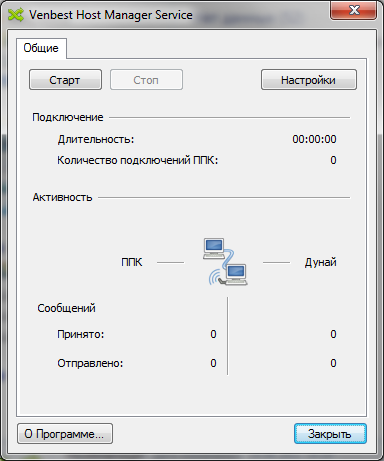
Development of the core high-performance software platform "Host Monitor" for end-to-end, secure data exchange between a distributed network of centralized monitoring facilities and the central monitoring station.
Business Objective & Technical Challenge
The primary economic task of the client was to drastically reduce the cost of the hardware infrastructure. The traditional approach required the purchase and maintenance of expensive hardware modules (decoders, expansion cards) on the central monitoring station side to receive and decode signals from alarm control panels (ACP).
The client made a strategic decision: to completely transfer the complex task of signal reception, decoding, and processing from hardware to the software layer.
To implement this concept, our team needed to develop a unique low-level module capable of intercepting and flawlessly recognizing communication signals between ACPs and the central security console. The main complexity lay in ensuring unprecedented speed and absolute fault tolerance of the system under avalanche-like incoming traffic.
Implemented Functionality & Architecture
Since security objects transmit test and alarm data packets with a high frequency, we designed an asynchronous multi-threaded architecture that met the core project requirements:
- High-Speed Packet Processing: Built a stable software core for parallel handling of incoming and outgoing data streams in real time without delays or queues.
- Emulation and Virtual COM Port Management: Developed an integration layer allowing the software to seamlessly interact with legacy hardware station protocols via virtualized interfaces.
- Data Encryption: Implemented end-to-end traffic encryption algorithms to protect communication channels from compromise, signal spoofing ("disarm" signals), or interception of alarm packets.
- Fault-Tolerant Logging: Configured an instantaneous system event logging mechanism. Log archiving is fully protected against data loss even in the event of an emergency power failure on the server.
Business Results
We successfully replaced the expensive hardware components with a flexible software solution, fully meeting the client's financial and technical KPIs. The software proved its ultimate reliability under extreme load conditions of centralized monitoring.

GoExcursion
Design and development of the global travel commerce platform GoExcursion — a large-scale B2C marketplace for searching, booking, and online ticket sales for excursions, attractions, and local landmarks worldwide.
Business Objective & Marketing Challenge
The client's main goal was to create not just another excursion display, but a comprehensive ecosystem for travelers that drives repeat sales through cross-selling marketing mechanics. It was critical to engineer a high-performance platform linking local activity ticketing directly with hotel accommodation incentives.
The key technical challenge for our team was automating the end-to-end loyalty logic: upon any ticket purchase, the system had to instantly generate a unique promotional code valid for booking hotels within the platform's proprietary global directory.
Implemented Functional Architecture
To ensure stable platform performance under multi-currency constraints and a highly distributed hotel catalog, we implemented the following specialized modules:
- Online Ticketing Module: Instant booking and electronic ticket generation system with QR-code support for entry validation at local attractions and tours.
- Global Hotel Inventory: An expansive worldwide hotel database with flexible filtration, rate management, and room reservation flows.
- Automated Promo Code Engine: A custom algorithm generating personalized accommodation discounts immediately following a successful ticket checkout.
- Payment Gateway Integration: Secure multi-currency transaction processing tailored for international travelers.
The Result
The GoExcursion platform was successfully launched into full commercial production, validating our team's expertise in engineering international e-commerce architectures. The delivered software allowed the client to deploy an effective loyalty marketing model without depending on expensive third-party loyalty aggregators.

QB Integration
Design and implementation of a specialized end-to-end integration module connecting the local 1C accounting system with the international QuickBooks Online platform to automate financial reporting under GAAP standards.
Business Problem & Hidden Operational Costs
The client enterprise manages its main operations in Ukraine, while its core stakeholders and investors are based in the United States. To maintain business transparency, leadership required continuous, real-time access to GAAP-compliant financial reporting.
Due to the lack of connectivity between systems, the client’s accounting team was forced to manually double-enter source data from 1C directly into QuickBooks.
This workflow caused significant data propagation delays, frequent human errors, and consumed immense financial and human resources on routine Excel cross-checks. Our team's objective was to fully automate this data pipeline.
Delivered Integration Functionality & Architecture
Instead of building a simple flat data duplicator, we engineered an intelligent connector equipped with custom transformation logic matching international accounting frameworks (IAS / GAAP):
- Mapping & Translation Tool: Developed a flexible rule-engine for income and expense item configuration, ensuring local accounting entries are accurately translated into the international schema.
- Smart Entity Identification: Integrated a module for transaction type and chart-of-accounts mapping, combined with automated vendor, customer, and inventory reconciliation between platforms.
- Automated Document Generation in QB Online: Enabled the automated creation of native Sales Receipt and Expense documents, alongside the real-time creation of associated entities (Vendors / Customers), products, and secure file attachment syncing.
- Hybrid Synchronization Modes: The integration supports both manual push triggers for precise data control and fully automated, scheduled background synchronization cycles.
Business Results
We successfully eliminated the accounting blind spot, completely offloading the financial team from time-consuming clerical work. US investors gained a transparent, dependable monitoring asset.

WeihtlossTeleMD
Turnkey design and development of a specialized online store for medical supplements and vitamins for the US market, seamlessly integrated with a telehealth platform and fully compliant with the federal HIPAA standard.
Business Task & Strict Legal Constraints
The primary challenge of the project was the strict US legislation, which prohibits the retail sale of therapeutic medical supplements and vitamins without an official doctor's prescription. A classic e-commerce model was completely inapplicable here. Our team faced the task of building an e-commerce platform from scratch and embedding a legal, automated medical compliance workflow into it.
The second critical requirement was ensuring absolute confidentiality of patients' medical data in accordance with the US federal HIPAA law. Any data leak exposed the client to multi-million dollar fines.
The Implemented IT Solution & Compliance Architecture
We engineered a custom web platform architecture combining e-commerce capabilities, telehealth workflows, and end-to-end drop-shipping supply chain automation:
- SNAPMD Telehealth Integration: Designed and deployed a unique end-to-end business flow. Prior to checkout, a buyer completes an online consultation with a licensed US medical professional directly on the website. Upon approval, the doctor issues a digital prescription, transitioning the order into a legally compliant sale.
- Multi-Level HIPAA Security Architecture: Protected Health Information (PHI) security was integrated into the core system layer, featuring end-to-end data encryption in transit and at rest, multi-factor authentication, rigorous activity logging, and the principle of least privilege (distributed role-based access to patient records).
- Supplier Logistics Automation: Built direct integration with distributor APIs. Following a successful payment transaction, orders are instantly routed to the specific supplier's warehouse, which handles fulfillment and ships directly to the end customer.
Business Results
We delivered a high-tech product that enabled the client to successfully deploy a fully compliant, automated e-commerce business model within one of the most strictly regulated markets in the world.
UATeleMD -telemedicine
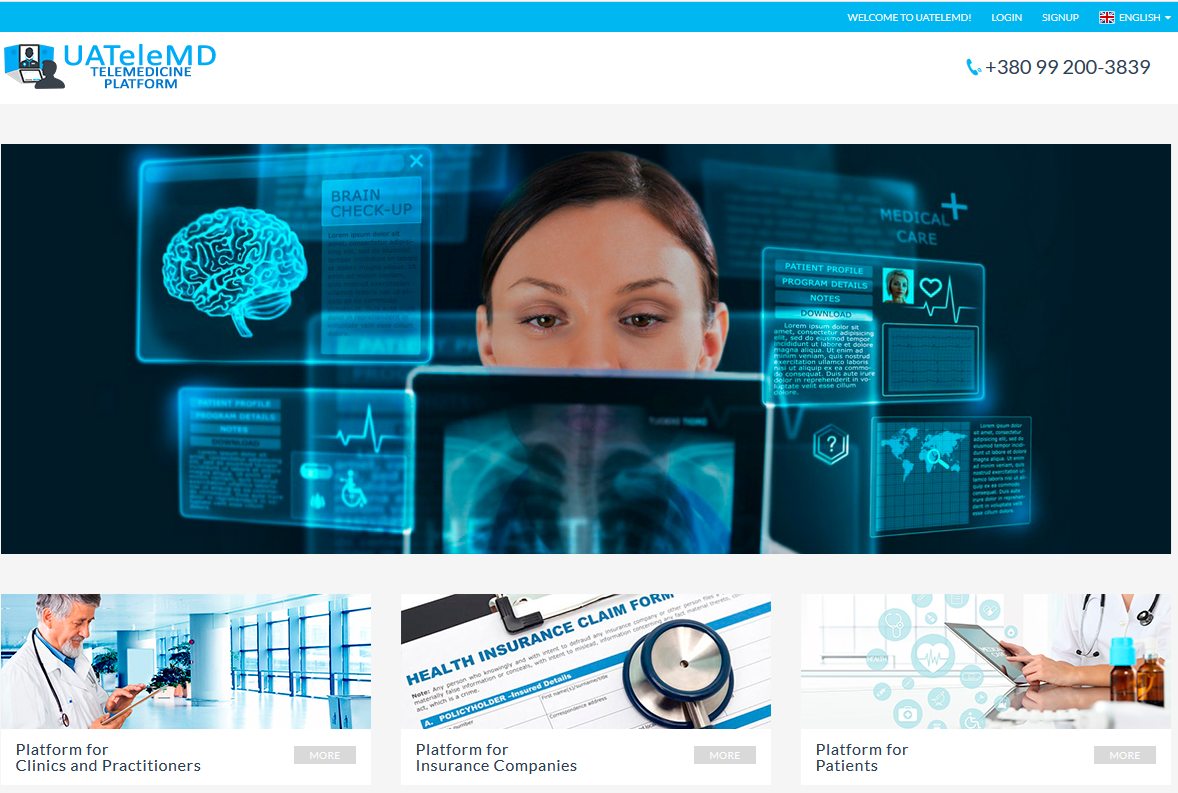
Turnkey design and development of the national telemedicine platform UATeleMD — a comprehensive Medical Information System (MIS) featuring secured online consultation workflows for private and network clinics.
Business Objective & Architectural Requirements
The primary goal of the project was to engineer a scalable B2B medical solution that clinics could easily customize and deploy under their own corporate branding. The platform was structured on a White Label model, requiring absolute data isolation across different medical centers within a unified application core.
The critical challenge was delivering uncompromised security for patient sensitive data. The system architecture was built from the ground up to comply with strict international regulatory standards, specifically GDPR (Europe) and HIPAA (USA), completely mitigating medical confidentiality breach risks.
Implemented IT Architecture & Transcending Technology Constraints
Within the framework of the MIS, we designed and deployed three autonomous workspaces and integrated a secure financial layer:
- Doctor Dashboard: A workspace for physicians featuring access to Electronic Health Records (EHR), treatment planning toolsets, and an embedded video consultation module.
- Patient Account: A personal profile for online booking, medical history retention, prescription digital management, and secured payment processing.
- Clinic Administrator Workspace: A control panel for scheduling management, physician coordination, business analytics tracking, and integration with LiqPay and Fondy payment gateways.
Overcoming Video Streaming Engineering Obstacles: During the architectural phase in mid-2019, our team attempted to establish proprietary video streaming powered by WebRTC. However, at that time, WebRTC proved to be too raw and unstable for medical-grade tasks where connection drops during an active consultation are completely unacceptable. Practice is a stubborn thing; thus, we rejected half-measures and integrated a custom solution from a professional global video streaming provider, ensuring seamless streaming stability.
Business Results
The UATeleMD platform demonstrated phenomenal stability and high demand during the COVID-19 pandemic. Ukrainian private clinics that deployed our White Label solution were able to instantly transition patient intake into a secure online environment.
Mobile app AMC
Turnkey design and development of the official corporate mobile application for the international network of private clinics, American Medical Centers (AMC), optimizing customer service and seamlessly merging e-commerce with medical insurance workflows.
Business Task: Mobility and Premium Service Experience
The American Medical Centers clinic network caters to expats, diplomats, and executive-level leadership, enforcing rigorous benchmarks for customer service quality and responsiveness. The client's core business challenge was to boost patient retention and transition conventional receptionist desk interactions into a fluid, user-friendly mobile channel.
The principal hurdle for our IT architecture was the integration of fintech payment modules handling not only standard bank cards but also verifying active coverage from international insurance providers.
Implemented Application Features
We engineered a native mobile solution acting as a secure digital pipeline between the patient and the clinic's internal Medical Information System (MIS):
- Intelligent Appointment Scheduling: An intuitive self-booking engine enabling patients to select a specialty, a specific practitioner, clinic location, and an optimal open time slot in just two taps.
- Hybrid Payment Gateway: Embedded secure in-app debit/credit card processing, coupled with a custom verification architecture linking the patient’s active insurance policy to auto-cover consultation costs.
- Secured Health Records (EHR): A personal dashboard granting instantaneous access to past consultation histories, physician treatment notes, lab results, and active medical prescriptions.
The Result
The mobile application for American Medical Centers was successfully architected, verified, and deployed to the App Store and Google Play. We successfully delivered a product that entirely removed the necessity for redundant call-center inquiries and on-hold wait times.
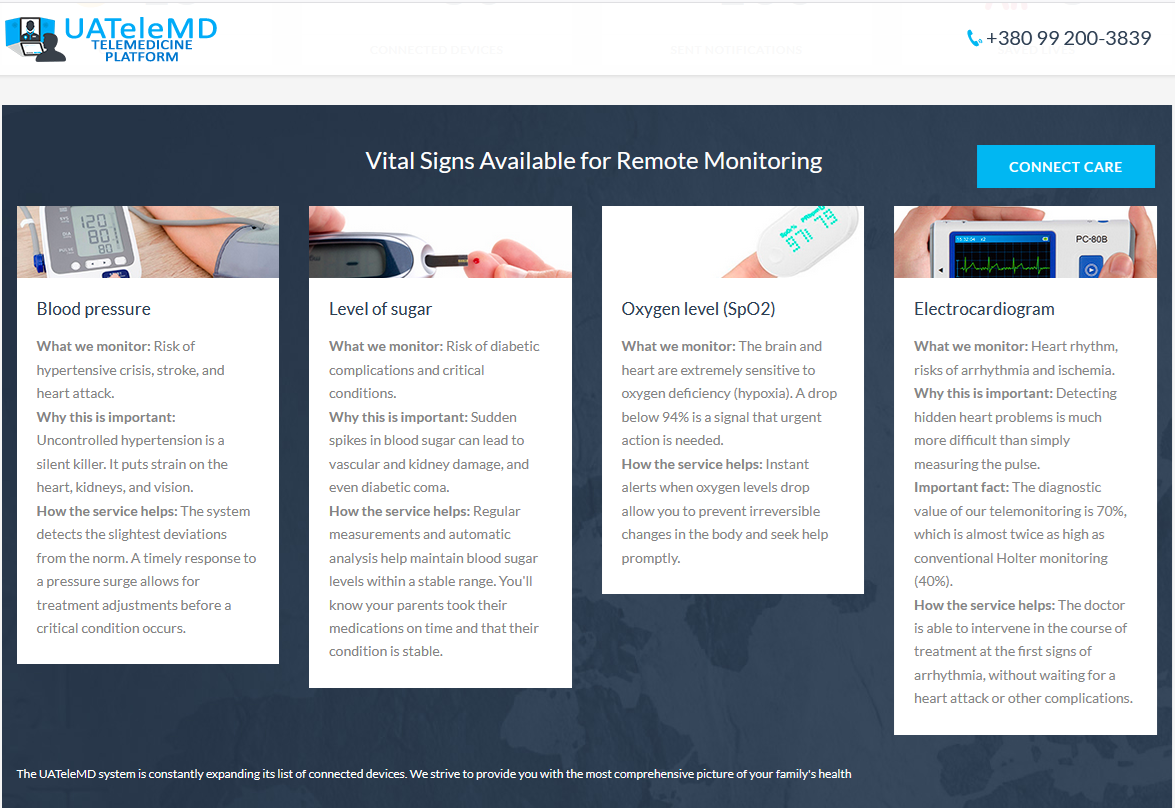
UATeleMD -remote patient monitoring
Turnkey design and development of a specialized Remote Patient Monitoring (RPM) module for the UATeleMD telemedicine platform, automating the aggregation of vital health biometrics and triggering emergency doctor alerts.
Business Objective: Transitioning from Reactive to Proactive Healthcare
Conventional telemedicine is typically confined to isolated online consultations. The client's main goal was to deliver a continuous care toolset for managing out-of-clinic patients with chronic conditions (such as hypertension, diabetes, and cardiovascular diseases).
Eliminating the critical "blind spot" between scheduled doctor appointments was paramount. Our team needed to develop a system for automated, round-the-clock evaluation of streams flowing from medical IoT devices and immediate response to hazardous health deviations.
Implemented Functionality & Monitoring Architecture
We engineered a fault-tolerant biometric processing architecture and deployed highly adaptive trigger-based alert configurations:
- Customizable Critical Triggers: Attending physicians can configure personalized health threshold baselines for each patient, including systolic/diastolic blood pressure, blood glucose tiers, blood oxygen saturation (SpO2), and arrhythmia markers.
- Instant Intelligent Alerting: The instant the system detects biometric logs deviating from an individual's safety threshold, it dispatches an emergency push notification or SMS alert to the clinic's on-duty medical staff for immediate clinical triage.
- Interactive Electronic Logbook: Developed a structured digital self-monitoring diary that automatically charts biometric trends, supports seamless data exports into universal formats, and enables secure, restricted remote sharing with affiliated parties (such as family members or caregivers).
The Result
The UATeleMD remote monitoring module transitioned the core application into a highly sophisticated preventative health platform. Medical facilities gained the leverage needed to mitigate sudden exacerbation risks, markedly elevating the quality and value of corporate patient care.

Mobile app UATeleMD
Design and development of the official UATeleMD mobile application for iOS and Android — a critical client-side IoT core component of the telehealth ecosystem enabling automated biometric data aggregation and synchronization.
Business Objective: Automating Data Acquisition on the Patient Side
The success of Remote Patient Monitoring (RPM) systems directly depends on patient compliance — the willingness of a patient to regularly and accurately record their health biometrics. Manual entry into paper notebooks or third-party apps often results in typos, data loss, or simple negligence.
Our team's primary challenge was to engineer a mobile hub that would fully automate data propagation from physical diagnostic hardware directly into the cloud telehealth platform, completely eliminating the human factor.
Technical Execution & Mobile M2M Integration
We designed a robust cross-platform application architecture and deployed low-level hardware integration modules:
- Direct Medical IoT Integration: Implemented custom communication protocols (including Bluetooth Low Energy / BLE) for direct wireless data harvesting from certified devices: blood pressure monitors, glucometers, pulse oximeters, and portable ECG devices.
- Hybrid Measurement Logbook: Built a structured interactive health diary inside the application. Device readings are populated instantaneously, while manual input triggers remain available for versatile user override.
- Seamless Cloud Synchronization: Engineered a fault-tolerant API background data transfer architecture. All captured measurements are immediately dispatched to the core database, instantly updating the patient's UATeleMD cloud web dashboard for prompt attending physician review.
The Result
The UATeleMD mobile application successfully bridged the gap between physical health devices and the clinic’s digital ecosystem. The solution immensely simplified independent home diagnostics for elderly users and chronic care patients.
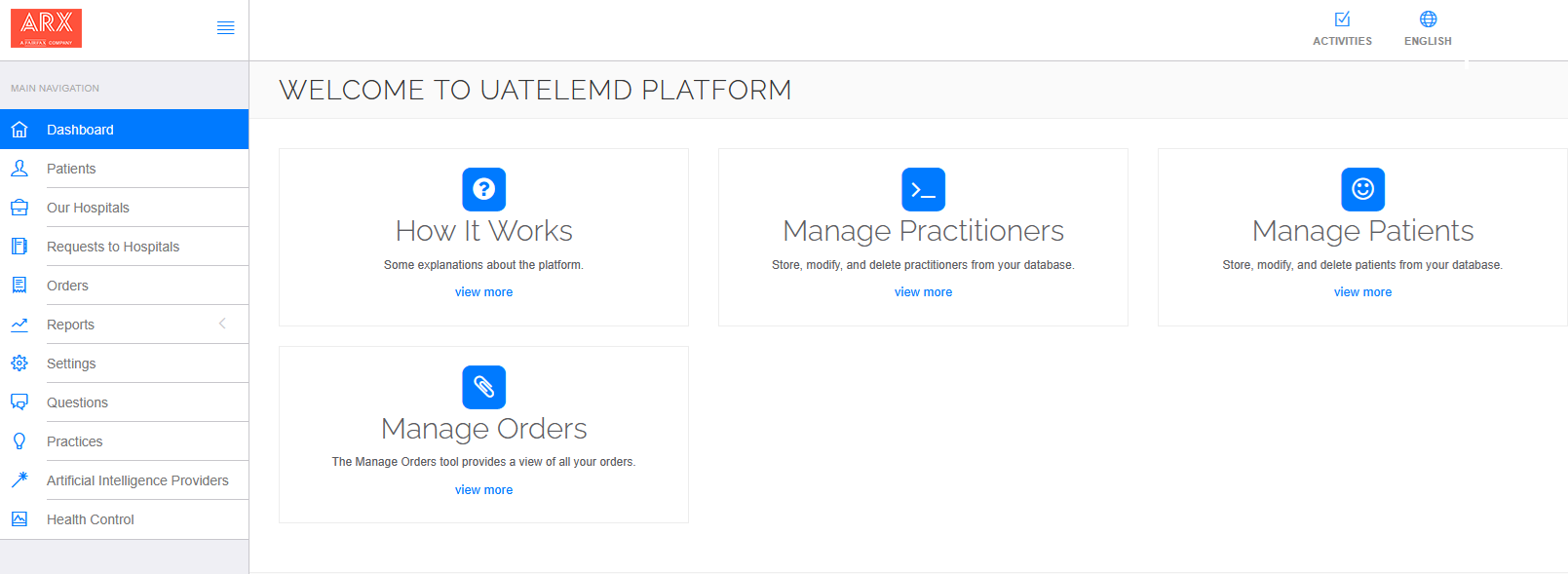
UATeleMD Insurance
Turnkey design and development of the specialized B2B module UATeleMD Insurance — a high-tech InsurTech solution bridging insurance providers and medical centers within a unified ecosystem for expedited insured patient intake.
Business Problem & Hidden Overhead in the Insurance Sector
The conventional process of coordinating medical care under an active insurance policy (Assistance) is traditionally bottlenecked by administrative tasks. Upon a client's claim request, insurance company operators had to manually call dozens of clinics, tracking open time slots, clinical capabilities, and pricing structures for specific lab work or screenings.
This fragmentation led to significant time loss, delayed patient care, and a ballooning assistance coordination staff.
Our team's challenge was to digitalize and automate this communication bridge, engineering an end-to-end medical service tendering infrastructure operating in real time.
Delivered IT Architecture & Workflow Logic
We designed and deployed an asynchronous request exchange system running on a strict and transparent operational flow:
- Intelligent Questionnaire Engine: Built an adaptive medical request constructor, empowering insurance operators to specify required care categories (specialist consultations, lab tests, or complex diagnostic screenings like MRI, CT, Ultrasound) in a single click.
- Automated Broadcast Routing: The system instantaneously distributes the configured query across the verified database of clinics hooked into the broader UATeleMD ecosystem.
- Clinic Feedback Interface: Integrated a streamlined response module inside medical center dashboards for rapid confirmation entries (available timing slots, accurate cost pricing, appointment confirmation).
- Offer Aggregator & Scheduling Flow: The insurance provider aggregates all incoming responses inside a single interface, presents a curated pool of optimal variants to the insured customer, and schedules the patient directly into the chosen clinic upon confirmation.
Business Results
The UATeleMD Insurance module markedly elevated insurance provider customer care benchmarks. We successfully established a clean digital environment that eliminated the human factor and long phone negotiations from the "Insurance to Clinic" fulfillment chain.
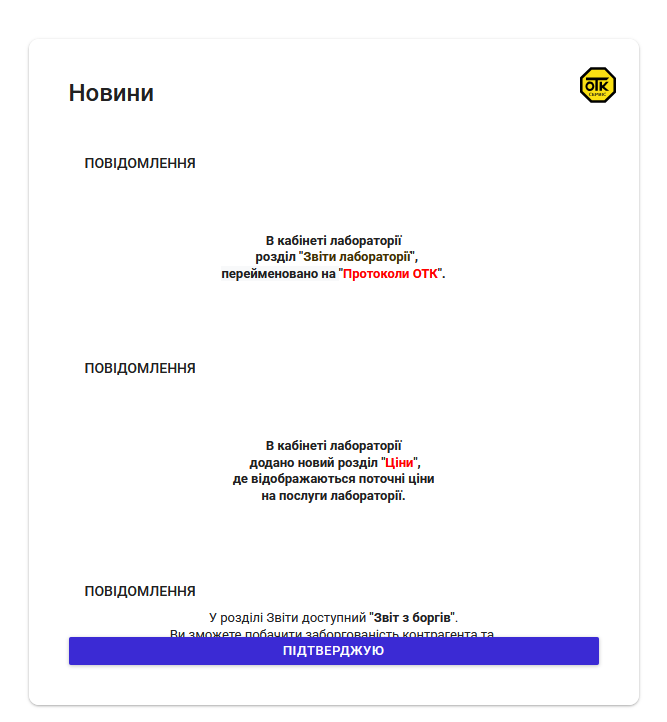
OTK Laboratory Workspace
Turnkey design and development of the specialized B2B web portal "Laboratory Workspace" for the management enterprise of a national network of automotive technical control (ATC) and vehicle certification laboratories.
Business Objective & Operational Challenge
The management company coordinating an expansive distributed network of partner and proprietary ATC laboratories faced massive accounting fragmentation. Financial settlements across general contractor and subcontractor agreements were decoupled, official compliance reporting templates lacked standardization, and monitoring margin leakages at individual stages of servicing corporate fleet accounts was practically impossible.
Our team was tasked with developing a highly secure, transparent digital single-window for laboratories, tightly coupling baseline operations, complex pricing matrices, and back-office ERP layers.
Delivered Functionality & Smart Architecture
We engineered a high-performance front-end system integrated with the central ERP software and external banking/payment networks:
- Order Management & Compliance Documentation: Deployed a complete order processing module generating regulated digital inspection records (ATC, international certification, CO2 emission logs, tachograph calibration certificates) in strict alignment with state legislative frameworks.
- Smart Pricing & Discount Rules Engine: Embedded an intelligent price calculation algorithm handling multi-tier commercial logic, volume-based rates, geographic coefficients, and customized discount profiles per subcontractor node.
- Integrated Fintech Infrastructure: Configured a seamless M2M integration with EasyPay POS terminals for on-site cash/card handling, supplemented by secure credit card input workflows and quick-response (QR-code) payment triggers.
- Embedded Mini-CRM & Analytics: Created a highly specialized customer retention CRM module for laboratory points, paired with automated operational report broadcasting to the central corporate headquarters.
Business Results
Launching the specialized B2B workspace entirely eliminated operational blind spots between the management enterprise and its subcontractor laboratory network. Rigid system constraints successfully protected the business against human input errors by 100%.
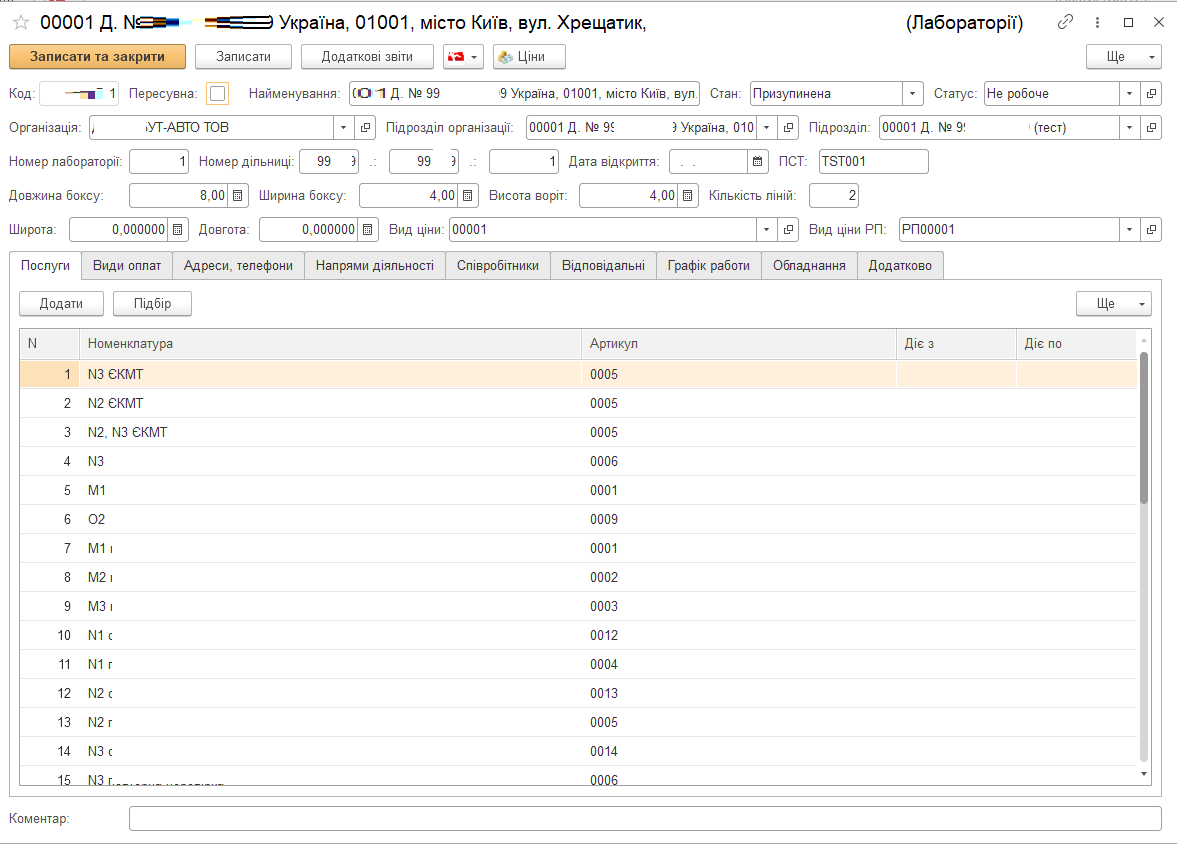
BAS ERP implementation OTK
Comprehensive architectural design and successful deployment of a customized BAS ERP system acting as the core back-office engine for the management enterprise of a national automotive technical control (ATC) laboratory network.
Business Objective: Forging an End-to-End Control Framework
Scaling a highly distributed network of ATC facilities compelled the management firm to shift to a modern tier of automation. The core business target was to interlink call-center workflows, multi-facility lab operations, and corporate stakeholder auditing into a single pipeline, neutralizing human input gaps and scheduling chaos.
The primary software engineering hurdle was interfacing the BAS ERP data core with an external high-load web infrastructure ("Laboratory Workspace"). The architecture needed to seamlessly process massive transactional streams flowing from the front-end layer in real time.
Delivered BAS ERP Custom Functionality
We deeply engaged with the operational constraints of the automotive service sector and deployed a tailored ecosystem of enterprise modules:
- Digital Laboratory Profile: Designed a specialized master-data entity aggregating legal, infrastructure, and financial baselines for individual inspection nodes (credit limits, specific pricing structures, fulfillment records).
- Ringostat Telephony Integration: Configured a fluid, native M2M connection between call-center pipelines and the ERP core. Upon inbound calls, operators instantly review patient profiles, booking history, and active fleet statuses, vastly boosting agent utility.
- Interactive Dispatch Scheduling Calendar: Embedded an ergonomic scheduling workspace for call-center agents. Dispatchers allocate incoming vehicles to open lab capacity slots in real time, preventing scheduling collisions and facility downtime.
- Centralized Back-End for Web Gateways: The BAS ERP framework was customized to serve as a robust back-end for the external web portal, managing automated work-orders, discount application logic, compliance cert generation, and EasyPay transactions.
- Executive BI Reporting Dashboard: Engineered a powerful business intelligence aggregation module that automatically synthesizes cross-network operational outputs, delivering corporate stakeholders granular auditing regarding margins and profit centers.
The Result
The BAS ERP implementation project was successfully fully delivered and operates with 100% computational stability, requiring no additional code maintenance or technical revisions. We validated our competence in engineering heavy database backbones while maintaining core upgrade capabilities amid deep custom programming.
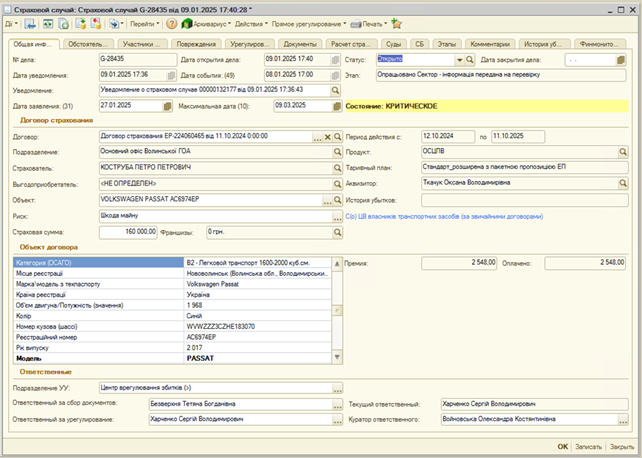
BAF/BAS - IC "Universalna"
Large-scale automation and deep customization of a BAS / BAF ERP enterprise system for Universal Insurance Company. Comprehensive modernization of claims management, reinsurance, underwriting, and anti-money laundering (AML) workflows.
Business Context & Technical Challenge Under the Hood
Our team stepped into an active project that had been long maintained by the client's internal IT department. Practice is a stubborn thing, and the absence of centralized architectural oversight resulted in fragmented, decentralized legacy code. The internal application layers were in a critical state ("complete chaos under the hood"), leaving business-critical workflows stalled for years while end-users coped manually.
Our engineers faced a double challenge: rapidly execute a comprehensive code audit and refactoring, establish strict architectural patterns, and simultaneously deliver intricate business logic across three pivotal insurance departments.
Delivered Functional Architecture per Department
1. Claims Management Department (Core Infrastructure)
- MTIBU State Integration: Fully automated the end-to-end data broadcasting of insurance claims to the centralized state database, eliminating manual entry.
- Annuity Payment Framework: Engineered a complex financial algorithm for automated calculation and strict scheduling of recurring long-term indemnity disbursements.
- Intelligent Claims File Handling: Deployed dynamic rule sets changing form configurations, field access, and claim file milestones based on specific product lines and policy risks.
- Financial Auditing & Layouts: Configured multi-currency logging for reserves and indemnity claims, while automating rejection certificate templates and print layouts for statutory insurance acts.
- VICIDIAL Connectivity & Underwriting: Wired a seamless M2M integration with the contact-center’s enterprise IP-telephony and completely overhauled BI analytical reports for underwriters.
2. Financial Monitoring & Compliance Department
- Sanction Risk Mitigation: Developed robust real-time counterparty validation rule sets tracking compliance across international and national sanction blacklists from scratch.
- FINAP API Integration: Modernized the data exchange layer with the FINAP system to handle immediate risk-scoring, neutralizing human oversight gaps during customer compliance reviews.
3. Reinsurance Department
- Risk Distribution Logging: Established a structured tracking environment for both facultative and treaty reinsurance setups (cessions/retrocessions).
- Change Log Management: Deployed a custom audit module for tracking and logging contract modifications, policy amendments, and addendums over active reinsurance treaties.
The Result
We brought absolute order to our assigned section of the IT infrastructure, bringing online features that the client's internal team had failed to launch for years. End-users who had abandoned hope received a perfectly fluid system handling MTIBU sync and denial automation. This project stands as proof of our team's capability to successfully salvage and stabilize highly complex enterprise platforms.